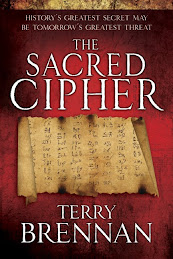
Finally looks like Spring, eh? Well, I’ve finally come up for air after a marathon season of editing for The Sacred Cipher.
Ever since I sent out the February Newsletter I’ve been under the gun with the editing process. At one stretch, I worked on the edits for the book every day for three weeks straight.
The result is that the book is better now than ever … and it’s still scheduled for a July 31 release date.
I was working with a dynamite editor at Kregel Publications, who really challenged me and my writing. The toughest challenge was in building more richly developed characters, and then strengthening each character’s motivation … why they were doing what they were doing. And then there were a gazillion different edits, fixes and rewrites of sections.
I just went through another week of work on the second round of edits. This time, a different editor reviewed the manuscript and found things we missed the previous round.
But it’s still the same story. The characters are just more real.
And now, the editing is DONE! Yeah! And the book has been sent off to the design department who will develop the inside design and layout of the pages. The book will go to press sometime in May or early June.
And be in your bookstores in July! If you want to get psyched, you can click on the trailer link below just to check out the 30 second trailer.
http://www.youtube.com/watch?v=9-QiJHa78E0
But here’s what I need you to do. And there will be more about this next month.
Identify the person or persons in your life who operate in lots of different circles – who know lots of different people. Talk to that person about The Sacred Cipher. Tell them how great a book it’s going to be (there you’ll have to take a step of faith).
And … ask that person to talk to their friends about the book. That is the best way to get Buzz going, and Buzz sells books.
The second thing you can do … if you are inclined … would be to join fan clubs, chat rooms, blogs, facebook groups for things like The DaVinci Code, or Bourne Identity and other Bourne movies, or Indiana Jones, or something in that vein. And then talk it up about, “This great new book that’s about to come out. It’s a lot like The DaVinci Code (or ????) …” That’s another great way to help get the word out.
And, if you are wondering what to say about the book, send me an email (terrbrennan@gmail.com) and I'll send you the Synopsis so you can brush up on the content. Hey … you guys are going to love this story. It’s a great summer read.
Thanks for your interest … and all your help.
Catch you next month.
Thursday, April 23, 2009

Friday, March 27, 2009
The Noble Tradition
If there has been one constant in all the writer's conferences I've attended, besides eating too much, it is that Anne Lamott's Bird by Bird - Some Instructions on Writing and Life, is always one of the most highly recommended books that starting writers "must have" in their generally unread collection of How To books.
It only took me four conferences to get to the book table early enough to snare a copy.
And this year I finally read it.
You should, too.
Bird provides so much fodder for comment I almost don't know where to start.
But I do.
How can a good Christian woman be so profane in her writing? Yikes!
How can a good Christian woman be so funny in her writing? Yikes!
How can ... well, you get it.
However, in between the yuks and the profanity is a garden of wisdom and solid counsel. Too much to cover. But here are some slices I loved from her chapter on Publication. (Other chapters include School Lunches, Jealousy, Broccoli, Radio Station KFKD and my favorite, Shitty First Drafts. Hey, they're not my chapter titles!)
After listing a litany of things that publication is not, Lamott allows herself to dance with the joy of being a published author.
"But the fact of publication is the acknowledgement from the community that you did your writing right. You acquire a rank that you never lose. Now you're a published writer, and you are in that rare position of getting to make a living, such as it is, doing what you love best. That knowledge does bring you a quiet joy."
Lamott is great at chronicling the pitfalls and false security of pursuing publication as the Holy Grail of your writing, but she also says this.
"But the truth is that there can be a great deal of satisfaction in being a writer, in being a person who gets some work done most days, and who has been published and acknowledged. I carry this around in my pocket, touch it a number of times a day to make sure it is still there. Even though so much of my writing time is stressful and disheartening, I carry a secret sense of accomplishment around with me, like a radium pack implanted near my heart that now leaches a quiet sense of relief through my system. But you pay through the nose for this."
Yes, the price is high. Deadly days of pounding out words and wondering if they make any sense ... if they will ever connect with another human being. It's a lonely work, full of self doubt that culminates in allowing people, most you've never met, skewer you and your work in public. Some fun, eh?
Lamott leaves us with some perspective.
"Being a writer is part of a noble tradition, as is being a musician - the last egalitarian and open associations. No matter what happens in terms of fame and fortune, dedication to writing is a marching-step forward from where you were before, when you didn't care about reaching out to the world, when you weren't hoping to contribute, when you were just standing there doing some job into which you had fallen."
Wow. Words like this make it all worth the price.
It only took me four conferences to get to the book table early enough to snare a copy.
And this year I finally read it.
You should, too.
Bird provides so much fodder for comment I almost don't know where to start.
But I do.
How can a good Christian woman be so profane in her writing? Yikes!
How can a good Christian woman be so funny in her writing? Yikes!
How can ... well, you get it.
However, in between the yuks and the profanity is a garden of wisdom and solid counsel. Too much to cover. But here are some slices I loved from her chapter on Publication. (Other chapters include School Lunches, Jealousy, Broccoli, Radio Station KFKD and my favorite, Shitty First Drafts. Hey, they're not my chapter titles!)
After listing a litany of things that publication is not, Lamott allows herself to dance with the joy of being a published author.
"But the fact of publication is the acknowledgement from the community that you did your writing right. You acquire a rank that you never lose. Now you're a published writer, and you are in that rare position of getting to make a living, such as it is, doing what you love best. That knowledge does bring you a quiet joy."
Lamott is great at chronicling the pitfalls and false security of pursuing publication as the Holy Grail of your writing, but she also says this.
"But the truth is that there can be a great deal of satisfaction in being a writer, in being a person who gets some work done most days, and who has been published and acknowledged. I carry this around in my pocket, touch it a number of times a day to make sure it is still there. Even though so much of my writing time is stressful and disheartening, I carry a secret sense of accomplishment around with me, like a radium pack implanted near my heart that now leaches a quiet sense of relief through my system. But you pay through the nose for this."
Yes, the price is high. Deadly days of pounding out words and wondering if they make any sense ... if they will ever connect with another human being. It's a lonely work, full of self doubt that culminates in allowing people, most you've never met, skewer you and your work in public. Some fun, eh?
Lamott leaves us with some perspective.
"Being a writer is part of a noble tradition, as is being a musician - the last egalitarian and open associations. No matter what happens in terms of fame and fortune, dedication to writing is a marching-step forward from where you were before, when you didn't care about reaching out to the world, when you weren't hoping to contribute, when you were just standing there doing some job into which you had fallen."
Wow. Words like this make it all worth the price.
Tuesday, March 24, 2009
How is your "Change" spelled?
So, here we are on March 24th, two months into the historic presidency of Barak Obama. The man who vowed to bring change not only to Washington, but to the entire country as well.
Obama appears to be fulfilling his promise.
I’m just wondering if the change this President is orchestrating is what 26 million Americans were expecting when they cast their votes for him.
What we know so far is that President Obama’s change will include universal health care (run by the government); a college education for anyone who wants one (paid for by the government); a punitive energy policy (run by the government, but paid for by every American through higher heating oil and gasoline prices); and the largest Public Works endeavor in the history of this nation (run by the government and paid for by our sons and daughters, grandsons and granddaughters, great grandsons and ...).
Okay, so we’re not that surprised that a liberal Democrat who posed as a “centrist” to get elected … like, for instance, Bill Clinton … would attempt to flex his muscles on the heels of an electoral “mandate”. And we’re not surprised this muscle flexing includes socialized medicine, socialized education and socialized public works.
What we are surprised about … and perhaps those 26 million who voted Democratic are surprised about … is that now this President is asking for the power to seize American business.
No, not just nationalize the American banking system, which has already begun.
No, now the reports out of Washington are that President Obama wants to give the Secretary of the Treasury the power to seize American businesses and to enforce a limit on compensation for executives. Not just businesses that have accepted some of the $700 billion bailout bribery – but any business the Secretary thought could create a problem for the economy should it fail. Not just executives who are on the government take, but any executive.
Now it appears as if President Obama's change will include socialized banking and socialized business … the government telling us who should survive, and how much they should make while they’re doing it.
Okay … I’m just being paranoid, right? The last time I wrote about Obama Socialism here, I got roasted on several fronts.
But, listen to this.
Dick Morris was on one of the talking-head shows after the President’s news conference. This is the Dick Morris who was the brains behind the Clinton campaigns and President Clinton’s closest advisor. A conservative Republican he is not.
So, this is what Dick Morris said about President Obama’s plans for change. Morris said the President wants to make a good show of trying to save the economy, but he wants to fail. He’s planning to fail. Then, when the country is in a real crisis, on the brink of disaster, Obama Socialism will come in like a flood to save the day.
That’s what Bill Clinton’s closest advisor said Tuesday night on national television.
President Obama held a news conference last night for one purpose … to put pressure on Congress to pass his proposed budget. He called it the centerpiece of the economic recovery program.
Good faith estimates from the Congressional Budget Office indicate the President’s proposed budget will add $1 trillion more, each year, to the federal deficit for the next ten years and beyond. That our interest payments on the national debt will be $800 billion dollars a year. Just the interest.
Barak Obama’s budget will bankrupt the country. No nation can afford to throw $1 trillion into the black hole of economic stimulus … see one-third of the nation’s wealth evaporate … then pay for socialized medicine, socialized education, socialized banks, socialized business and the largest public works project in our history.
Perhaps Dick Morris is wrong. Perhaps President Obama is not willfully steering this nation into catastrophe. Perhaps he is not planning to destroy this nation so he can rebuild it in his own image.
Whether Barak Obama is acting willfully to bring this country to its knees or not, he is clearly focused on accomplishing the change that he pledged to bring to this nation.
Change that is spelled r-e-v-o-l-u-t-i-o-n.
Obama appears to be fulfilling his promise.
I’m just wondering if the change this President is orchestrating is what 26 million Americans were expecting when they cast their votes for him.
What we know so far is that President Obama’s change will include universal health care (run by the government); a college education for anyone who wants one (paid for by the government); a punitive energy policy (run by the government, but paid for by every American through higher heating oil and gasoline prices); and the largest Public Works endeavor in the history of this nation (run by the government and paid for by our sons and daughters, grandsons and granddaughters, great grandsons and ...).
Okay, so we’re not that surprised that a liberal Democrat who posed as a “centrist” to get elected … like, for instance, Bill Clinton … would attempt to flex his muscles on the heels of an electoral “mandate”. And we’re not surprised this muscle flexing includes socialized medicine, socialized education and socialized public works.
What we are surprised about … and perhaps those 26 million who voted Democratic are surprised about … is that now this President is asking for the power to seize American business.
No, not just nationalize the American banking system, which has already begun.
No, now the reports out of Washington are that President Obama wants to give the Secretary of the Treasury the power to seize American businesses and to enforce a limit on compensation for executives. Not just businesses that have accepted some of the $700 billion bailout bribery – but any business the Secretary thought could create a problem for the economy should it fail. Not just executives who are on the government take, but any executive.
Now it appears as if President Obama's change will include socialized banking and socialized business … the government telling us who should survive, and how much they should make while they’re doing it.
Okay … I’m just being paranoid, right? The last time I wrote about Obama Socialism here, I got roasted on several fronts.
But, listen to this.
Dick Morris was on one of the talking-head shows after the President’s news conference. This is the Dick Morris who was the brains behind the Clinton campaigns and President Clinton’s closest advisor. A conservative Republican he is not.
So, this is what Dick Morris said about President Obama’s plans for change. Morris said the President wants to make a good show of trying to save the economy, but he wants to fail. He’s planning to fail. Then, when the country is in a real crisis, on the brink of disaster, Obama Socialism will come in like a flood to save the day.
That’s what Bill Clinton’s closest advisor said Tuesday night on national television.
President Obama held a news conference last night for one purpose … to put pressure on Congress to pass his proposed budget. He called it the centerpiece of the economic recovery program.
Good faith estimates from the Congressional Budget Office indicate the President’s proposed budget will add $1 trillion more, each year, to the federal deficit for the next ten years and beyond. That our interest payments on the national debt will be $800 billion dollars a year. Just the interest.
Barak Obama’s budget will bankrupt the country. No nation can afford to throw $1 trillion into the black hole of economic stimulus … see one-third of the nation’s wealth evaporate … then pay for socialized medicine, socialized education, socialized banks, socialized business and the largest public works project in our history.
Perhaps Dick Morris is wrong. Perhaps President Obama is not willfully steering this nation into catastrophe. Perhaps he is not planning to destroy this nation so he can rebuild it in his own image.
Whether Barak Obama is acting willfully to bring this country to its knees or not, he is clearly focused on accomplishing the change that he pledged to bring to this nation.
Change that is spelled r-e-v-o-l-u-t-i-o-n.
Thursday, March 19, 2009
The Hell Formerly Known as Editing
This blog originally appeared on March 17th as a guest blog on Rants & Ramblings, the blog of my agent, Rachelle Gardner. It recounts some of my experiences during the editing process for my first novel, The Sacred Cipher, scheduled for release in July.
It was June 30, 2008 and my wife and I were driving home from the Adirondacks when Rachelle called. “How does it feel to be a published author?”When I stopped dancing around the car – yes, I had parked first – my head was spinning. It still is. But the dreams of fame and fortune, which so quickly sprang to mind that day, have been put on hold. First comes editing.
I signed a contract with Kregel for my first novel, The Sacred Cipher. We’ve been through two rounds of editing with three more to come. The release date has been shuffled from April to July 31 of this year.The first thing I must say is that the people I've worked with at Kregel have been great. They are all professional; holding to high standards; clear and articulate in their counsel, questions and needs. They’ve been compassionate and sensitive in their delivery, open to suggestions or differences of opinion and deferential to the author's vision.No complaints on that side.But the editing process is exhausting and, at times, frightening. Twice I thought this train was headed off the bridge.My editor, Dawn Anderson, presented me with a laundry list of edits, deletions and revisions – some quite extensive. The big issues (extensive character development; character motivation; plot pacing) were too big to tackle at the beginning. They overwhelmed me. So, first, I read through the entire manuscript.Then I went back and started fixing the 'smaller' problems, keeping the big issues in mind and keeping notes of my own thoughts. That helped me make progress while I was still thinking through the major issues.In addition, Dawn asked two perceptive, but alarming, questions about timing – one at the beginning of the book (I wrote that four years ago!) and a second about the conclusion – so substantial, I thought the book was dead. It took four days to find a solution.POV was a nagging, consistent issue, but dealing with the characters was my biggest problem. Each of the main characters needed more depth and development but the great challenge was motivation … why would they do this? Too many times, my first answer was, “I don’t know.”I worked on the revisions at least four days a week for nearly a month. Even with all the revisions ... 98.5% of my editor’s observations or requests were valid … the story is the same, the characters are the same (though deeper) and the plot still moves. I'm okay with it.It helped a lot to hear from Rachelle that significant edits and revisions like this are not unusual. So, I didn't take the requests personally.All that said, editing is a big deal. The revisions were harder work than the writing. At least, that's how it felt. I think I was having selective amnesia. I know there were several very bleak days in the writing, as well. But, in the editing stage, there was more at stake. More downside risk. Much more challenge to be a 'better' writer.As a result, I am physically and emotionally spent. Squeezed out and hung to dry. Brain dead and bug eyed. And tired of talking about this book. (I've done a really good job of marketing to everyone I know ... and they ALL ask!). But the edits keep coming. A freelance editor will be reviewing it for substance, internal editors will do a line edit, then a copy edit.Honestly, I'm numb. There have been so many days of doubt. I think the book is good ... the folks at Kregel are excited about it. And I believe it's better now than ever.But I’m not dancing around the car anymore. Not now. I won't be able to believe this rumor about being a published author until I have one of those 362-page suckers in my hand. This process is just too fragile to take anything for granted.
It was June 30, 2008 and my wife and I were driving home from the Adirondacks when Rachelle called. “How does it feel to be a published author?”When I stopped dancing around the car – yes, I had parked first – my head was spinning. It still is. But the dreams of fame and fortune, which so quickly sprang to mind that day, have been put on hold. First comes editing.
I signed a contract with Kregel for my first novel, The Sacred Cipher. We’ve been through two rounds of editing with three more to come. The release date has been shuffled from April to July 31 of this year.The first thing I must say is that the people I've worked with at Kregel have been great. They are all professional; holding to high standards; clear and articulate in their counsel, questions and needs. They’ve been compassionate and sensitive in their delivery, open to suggestions or differences of opinion and deferential to the author's vision.No complaints on that side.But the editing process is exhausting and, at times, frightening. Twice I thought this train was headed off the bridge.My editor, Dawn Anderson, presented me with a laundry list of edits, deletions and revisions – some quite extensive. The big issues (extensive character development; character motivation; plot pacing) were too big to tackle at the beginning. They overwhelmed me. So, first, I read through the entire manuscript.Then I went back and started fixing the 'smaller' problems, keeping the big issues in mind and keeping notes of my own thoughts. That helped me make progress while I was still thinking through the major issues.In addition, Dawn asked two perceptive, but alarming, questions about timing – one at the beginning of the book (I wrote that four years ago!) and a second about the conclusion – so substantial, I thought the book was dead. It took four days to find a solution.POV was a nagging, consistent issue, but dealing with the characters was my biggest problem. Each of the main characters needed more depth and development but the great challenge was motivation … why would they do this? Too many times, my first answer was, “I don’t know.”I worked on the revisions at least four days a week for nearly a month. Even with all the revisions ... 98.5% of my editor’s observations or requests were valid … the story is the same, the characters are the same (though deeper) and the plot still moves. I'm okay with it.It helped a lot to hear from Rachelle that significant edits and revisions like this are not unusual. So, I didn't take the requests personally.All that said, editing is a big deal. The revisions were harder work than the writing. At least, that's how it felt. I think I was having selective amnesia. I know there were several very bleak days in the writing, as well. But, in the editing stage, there was more at stake. More downside risk. Much more challenge to be a 'better' writer.As a result, I am physically and emotionally spent. Squeezed out and hung to dry. Brain dead and bug eyed. And tired of talking about this book. (I've done a really good job of marketing to everyone I know ... and they ALL ask!). But the edits keep coming. A freelance editor will be reviewing it for substance, internal editors will do a line edit, then a copy edit.Honestly, I'm numb. There have been so many days of doubt. I think the book is good ... the folks at Kregel are excited about it. And I believe it's better now than ever.But I’m not dancing around the car anymore. Not now. I won't be able to believe this rumor about being a published author until I have one of those 362-page suckers in my hand. This process is just too fragile to take anything for granted.
Friday, February 27, 2009
The Shades of Love
I've been wanting to share this for a week. Wasn't sure how to go about it. So, I'll just spit it out.
Here's Terry's Tip for Feb. 27. I recently finished reading three great books ... The Given Day by Dennis Lehane and The Road by Cormack McCarthy.
Dennis Lehane wrote Mystic River. I started that book (my son, Matt, loves Lehane), but the language was tough to take.
I was amazed by The Given Day. It's a wonderful story, epic in proportion, intimate in family.
But what shocked me was the lyricism of Lehane's writing. His wonderful turn of phrases, sparkling word pictures. It reads like the best Steinbeck. But I loved how he intertwined smells into his scene tapestries. Smells ... something I ignore too frequently in my scenes. But how strong, and powerful and seductive are smells.
The Given Day is a rough story in spots, Lehane is gritty, but I didn't want it to end.
The Road is absolutely mind-blowing. McCarthy has a style like none other I've ever seen. No chapters, for one. He creates a foreign, forbidding world and enchants you into its center. Two characters you ache for. That's all I can tell you without giving too much away. It's spectacular.
The third book? Yesterday I finished reading The Shack. Wow! What a revelation. My wife got it from the library and we all read it before it was due back. Now, I've got to go out and buy myself a copy. There's just too much in there to absorb, and remember, in just one reading. Fascinating.
Odd thing ... all three books are about love. Expectations of love in The Given Day. Responsibilities of love in The Road. And the gift of love in The Shack.
It's all love. Two are enslaving. One is freeing. We all have a choice which one, or two, or three we would like in our lives.
Ciao.
Pretty cool, this writing stuff.
Here's Terry's Tip for Feb. 27. I recently finished reading three great books ... The Given Day by Dennis Lehane and The Road by Cormack McCarthy.
Dennis Lehane wrote Mystic River. I started that book (my son, Matt, loves Lehane), but the language was tough to take.
I was amazed by The Given Day. It's a wonderful story, epic in proportion, intimate in family.
But what shocked me was the lyricism of Lehane's writing. His wonderful turn of phrases, sparkling word pictures. It reads like the best Steinbeck. But I loved how he intertwined smells into his scene tapestries. Smells ... something I ignore too frequently in my scenes. But how strong, and powerful and seductive are smells.
The Given Day is a rough story in spots, Lehane is gritty, but I didn't want it to end.
The Road is absolutely mind-blowing. McCarthy has a style like none other I've ever seen. No chapters, for one. He creates a foreign, forbidding world and enchants you into its center. Two characters you ache for. That's all I can tell you without giving too much away. It's spectacular.
The third book? Yesterday I finished reading The Shack. Wow! What a revelation. My wife got it from the library and we all read it before it was due back. Now, I've got to go out and buy myself a copy. There's just too much in there to absorb, and remember, in just one reading. Fascinating.
Odd thing ... all three books are about love. Expectations of love in The Given Day. Responsibilities of love in The Road. And the gift of love in The Shack.
It's all love. Two are enslaving. One is freeing. We all have a choice which one, or two, or three we would like in our lives.
Ciao.
Pretty cool, this writing stuff.
Wednesday, February 25, 2009
State of Who's Union?
One of the great benefits of history is that it gives us perspective ... perspective of not only what happened in the past, but why it happened. And a perspective with which to measure and assess the present.
I listened to all of President Obama's State of the Union speech last night. It is certainly clear to all Americans that "Now is the time ..." for perspective.
Over the last two years we have endured what may be the greatest economic collapse in the history of this nation.
No one knows for sure where this fiscal disaster will stop. What we do know is that the rate of decline continues to accelerate. One third of the total jobs lost during this two-year recession have been lost in the last three months. The last quarter of 2008 saw the greatest decline in home values in generations. Home values in many California communities have declined 50% ... 35 to 40% in many Florida communities.
We are suffering through an economic cataclysm of historic proportions. Only history will tell us if this time is, in fact, The Great Depression.
At the same time, our nation has undergone the greatest political cataclysm since Thomas Jefferson authored the Declaration of Independence.
Last month, I watched all day as our nation inaugurated an African-American man as President of the United States. Make no doubt about this point ... that day was the change of an age. Nothing will ever be the same again.
The age of the Baby Boomers has ended ... at least their control over the age.
When I was a boy, African-American men and women in the South could not chose their own seats on a bus. They could not eat in "white-only" restaurants; they could not drink from "white-only" water fountains.
A colleague of mine, a man who must be at least 10 years my junior, told me recently his grandfather was born a slave. Imagine that. A grandfather who was born a slave.
And, today, we have an African-American man as President, and there has not been rioting in the streets or acts of civil disobedience ... or the secession of states to form their own union.
This is a new age ... something we have never seen before.
So, we are living through the greatest economic and greatest political cataclysms - perhaps - in the history of our nation.
Which leads me to wonder ... what comes next? And what will it mean?
In the days after 9/11, the people of this nation were, in the vast majority, willing to surrender some of their rights for security - whether real or imagined. We were all afraid of what would come next. I know, living in New York City, I was. And we wanted the government, the military, to protect us from these mad terrorists.
Now, in the first days of his Presidency, Mr. Obama has closed the detention camp at Guantanamo and ordered an end to torture during interrogation. In the days after 9/11, putting suspected terrorists in detention anywhere, and using extraordinary measures to protect our citizens, may have looked a lot more palatable. Today, in hindsight, they look like big mistakes.
So, last night, I heard our President - and God bless him and help him make wise decisions - say that he wanted government to dictate what proper business practices would be in this new age; that he wanted government to determine how banks should function; that he wanted health care for every citizen; that every student has the right to go to college; that he wanted to tax the richest 2% of Americans to help pay for his plans.
And ... all this is the face of the largest spending bill in the history of this nation - the $1 trillion economic stimulus package - that was passed by Congress in less time than it takes to renew your driver's license at the DMV office.
Yes ... we need to do something to try and shore up the economic disaster that threatens the very fabric of our society. Doing nothing is not an option.
But, what I wonder is, what will history tell us, once we have a chance to shine the light of perspective on this time?
Will it tell us that the Federal government made all the right decisions, spent all its money wisely, resurrected economic growth - and then got out of the free market system?
Or, will history tell us that we just entered a new age. The age of a socialist America?
I listened to all of President Obama's State of the Union message last night. And what I heard made me fear even more for the future of this nation.
I'm concerned that, in the name of economic stability, we are inviting socialism to replace democracy. That we are ready to jettison our republic in favor of expediency.
And I fear for our future. Good intentions in dangerous times have led us to disastrous blunders in the past. And what happens when there is another cataclysm added to what has transpired so far? What happens if, God forbid, terrorists once again defile this nation and its people?
Is that the day we move from the age of democracy and freedom to socialism and dictatorship?
Is that possibility so far away? Or, is Now the time?
I listened to all of President Obama's State of the Union speech last night. It is certainly clear to all Americans that "Now is the time ..." for perspective.
Over the last two years we have endured what may be the greatest economic collapse in the history of this nation.
No one knows for sure where this fiscal disaster will stop. What we do know is that the rate of decline continues to accelerate. One third of the total jobs lost during this two-year recession have been lost in the last three months. The last quarter of 2008 saw the greatest decline in home values in generations. Home values in many California communities have declined 50% ... 35 to 40% in many Florida communities.
We are suffering through an economic cataclysm of historic proportions. Only history will tell us if this time is, in fact, The Great Depression.
At the same time, our nation has undergone the greatest political cataclysm since Thomas Jefferson authored the Declaration of Independence.
Last month, I watched all day as our nation inaugurated an African-American man as President of the United States. Make no doubt about this point ... that day was the change of an age. Nothing will ever be the same again.
The age of the Baby Boomers has ended ... at least their control over the age.
When I was a boy, African-American men and women in the South could not chose their own seats on a bus. They could not eat in "white-only" restaurants; they could not drink from "white-only" water fountains.
A colleague of mine, a man who must be at least 10 years my junior, told me recently his grandfather was born a slave. Imagine that. A grandfather who was born a slave.
And, today, we have an African-American man as President, and there has not been rioting in the streets or acts of civil disobedience ... or the secession of states to form their own union.
This is a new age ... something we have never seen before.
So, we are living through the greatest economic and greatest political cataclysms - perhaps - in the history of our nation.
Which leads me to wonder ... what comes next? And what will it mean?
In the days after 9/11, the people of this nation were, in the vast majority, willing to surrender some of their rights for security - whether real or imagined. We were all afraid of what would come next. I know, living in New York City, I was. And we wanted the government, the military, to protect us from these mad terrorists.
Now, in the first days of his Presidency, Mr. Obama has closed the detention camp at Guantanamo and ordered an end to torture during interrogation. In the days after 9/11, putting suspected terrorists in detention anywhere, and using extraordinary measures to protect our citizens, may have looked a lot more palatable. Today, in hindsight, they look like big mistakes.
So, last night, I heard our President - and God bless him and help him make wise decisions - say that he wanted government to dictate what proper business practices would be in this new age; that he wanted government to determine how banks should function; that he wanted health care for every citizen; that every student has the right to go to college; that he wanted to tax the richest 2% of Americans to help pay for his plans.
And ... all this is the face of the largest spending bill in the history of this nation - the $1 trillion economic stimulus package - that was passed by Congress in less time than it takes to renew your driver's license at the DMV office.
Yes ... we need to do something to try and shore up the economic disaster that threatens the very fabric of our society. Doing nothing is not an option.
But, what I wonder is, what will history tell us, once we have a chance to shine the light of perspective on this time?
Will it tell us that the Federal government made all the right decisions, spent all its money wisely, resurrected economic growth - and then got out of the free market system?
Or, will history tell us that we just entered a new age. The age of a socialist America?
I listened to all of President Obama's State of the Union message last night. And what I heard made me fear even more for the future of this nation.
I'm concerned that, in the name of economic stability, we are inviting socialism to replace democracy. That we are ready to jettison our republic in favor of expediency.
And I fear for our future. Good intentions in dangerous times have led us to disastrous blunders in the past. And what happens when there is another cataclysm added to what has transpired so far? What happens if, God forbid, terrorists once again defile this nation and its people?
Is that the day we move from the age of democracy and freedom to socialism and dictatorship?
Is that possibility so far away? Or, is Now the time?
Wednesday, February 18, 2009
Edward Elgar - An Enigma
Hi,
Did you ever dream of breaking a secret code? Well, here's your chance.
This month, we're going to give you a little sneak peek at one of the plot elements that help drive The Sacred Cipher. And we'll also give you a chance to solve a 100-year-old code that has never been broken.
He was a chemist – in his basement. He was a cryptographer and code breaker – in his spare time. He went to work in an insane asylum – to find the peace he sought to compose music.
But, if you watch much TV, or many movies, then you’re likely to have also heard Sir Edward Elgar’s work. There was a series on television about World War II – Band of Brothers. Click on this youtube connection below and see if this sounds familiar.
http://www.youtube.com/watch?v=sUgoBb8m1eE
This music is Nimrod, one of the “Variations on an Original Theme” Elgar wrote to widespread acclaim in 1899 – his now famous Enigma Variations, some of the most beautiful music this world has ever heard. Elgar’s compositions are vast and varied, far too many to comment on here – his Cello Concerto; the Music Makers; his 1st Symphony and his masterful the Dream of Gerontius (1900).
The 75th Anniversary of Elgar’s death will be celebrated on February 28th by a commemorative concert played by the renowned English Symphony Orchestra (ESO) at the Worcester Cathedral in England. Continuum has just published a book on Elgar, Elgar: An Anniversary Portrait … Introduced by Nicholas Kenyon. The liner notes read:
The Dorabella Cipher is one of the key elements that Tom Bohannon and his team – Dr. Richard Johnson, Sammy Rizzo and Joe Rodriguez – use to solve the mystery of The Sacred Cipher, my first novel which will be published by Kregel Publications and released on July 31.
The Elgar Society (http://www.elgar.org/) holds an annual competition for those code-breakers who are attempting to crack the Dorabella Cipher. In 2008 there were seven entries submitted, but the cipher remains a mystery and the £1,500 prize has yet to be awarded.
Can you break the Dorabella Cipher written by Sir Edward Elgar?
If you want to win the prize, perhaps reading The Sacred Cipher may help. But, if you can't wait the five monts until the book is released, next month, we'll give you some more history of the Dorabella Cipher, and some more clues.
And, oh yeah, Sir Edward Elgar is the man who opened the EMI Recording Studios on Abbey Road in November, 1931. You remember Abbey Road, right? Some English group made an album of that title. Can’t quite remember their name.
Click below to see a rare piece of film - Elgar conducting his Pomp and Circumstance at the opening of the Abbey Road Studios.
http://www.youtube.com/watch?v=gxqFdcZz974
Did you ever dream of breaking a secret code? Well, here's your chance.
This month, we're going to give you a little sneak peek at one of the plot elements that help drive The Sacred Cipher. And we'll also give you a chance to solve a 100-year-old code that has never been broken.
****
He was a chemist – in his basement. He was a cryptographer and code breaker – in his spare time. He went to work in an insane asylum – to find the peace he sought to compose music.
Sir Edward Elgar, one of the most beloved and influential English composers of this age … a romantic scientist of music … died 75 years ago.
Elgar passed away on February 23, 1934. Yet, his music is as alive today – as modern and well-known; as ingrained in our society – as the music of the Beatles.
Who is Edward Elgar?
Have you ever heard the Pomp and Circumstances March … the music that is played at every school graduation ceremony? Then you’ve heard Sir Edward Elgar.
But, if you watch much TV, or many movies, then you’re likely to have also heard Sir Edward Elgar’s work. There was a series on television about World War II – Band of Brothers. Click on this youtube connection below and see if this sounds familiar.
http://www.youtube.com/watch?v=sUgoBb8m1eE
This music is Nimrod, one of the “Variations on an Original Theme” Elgar wrote to widespread acclaim in 1899 – his now famous Enigma Variations, some of the most beautiful music this world has ever heard. Elgar’s compositions are vast and varied, far too many to comment on here – his Cello Concerto; the Music Makers; his 1st Symphony and his masterful the Dream of Gerontius (1900).
The 75th Anniversary of Elgar’s death will be celebrated on February 28th by a commemorative concert played by the renowned English Symphony Orchestra (ESO) at the Worcester Cathedral in England. Continuum has just published a book on Elgar, Elgar: An Anniversary Portrait … Introduced by Nicholas Kenyon. The liner notes read:
This collection of essays offers a new insight into the composer's life.
Edward Elgar was a man of many contradictions. He was born an outsider, into a family of lower-middle class, Catholic, origins. Yet his fame, and ability to write music that struck a chord in the national consciousness, led him to adopt a sycophantic attitude towards the Royal Family and high society, even though he always felt ill at ease with them.
Elgar was a depressive with a problematic marriage, who craved recognition, but in many ways he regretted the piece of music which made him famous. 'Pomp and Circumstance' made him the leading English composer of his age, but also contributed to the jingoism which he so disliked during the First World War. Yet, unquestionably, he was the greatest musical genius that England had produced in centuries.
This Portrait, by some of the scholars and musicians that understand him best, offers new light on a wide range of aspects of Edward Elgar's life and work.
Why do I care about Sir Edward Elgar? On the surface, my interest has little direct connection to his music. It has to do with the Dorabella Cipher – a code Elgar wrote in 1897 as a birthday present to a friend … a code that has never been broken.
The Dorabella Cipher is one of the key elements that Tom Bohannon and his team – Dr. Richard Johnson, Sammy Rizzo and Joe Rodriguez – use to solve the mystery of The Sacred Cipher, my first novel which will be published by Kregel Publications and released on July 31.
The Elgar Society (http://www.elgar.org/) holds an annual competition for those code-breakers who are attempting to crack the Dorabella Cipher. In 2008 there were seven entries submitted, but the cipher remains a mystery and the £1,500 prize has yet to be awarded.
Can you break the Dorabella Cipher written by Sir Edward Elgar?
If you want to win the prize, perhaps reading The Sacred Cipher may help. But, if you can't wait the five monts until the book is released, next month, we'll give you some more history of the Dorabella Cipher, and some more clues.
And, oh yeah, Sir Edward Elgar is the man who opened the EMI Recording Studios on Abbey Road in November, 1931. You remember Abbey Road, right? Some English group made an album of that title. Can’t quite remember their name.
Click below to see a rare piece of film - Elgar conducting his Pomp and Circumstance at the opening of the Abbey Road Studios.
http://www.youtube.com/watch?v=gxqFdcZz974
Subscribe to:
Posts (Atom)